
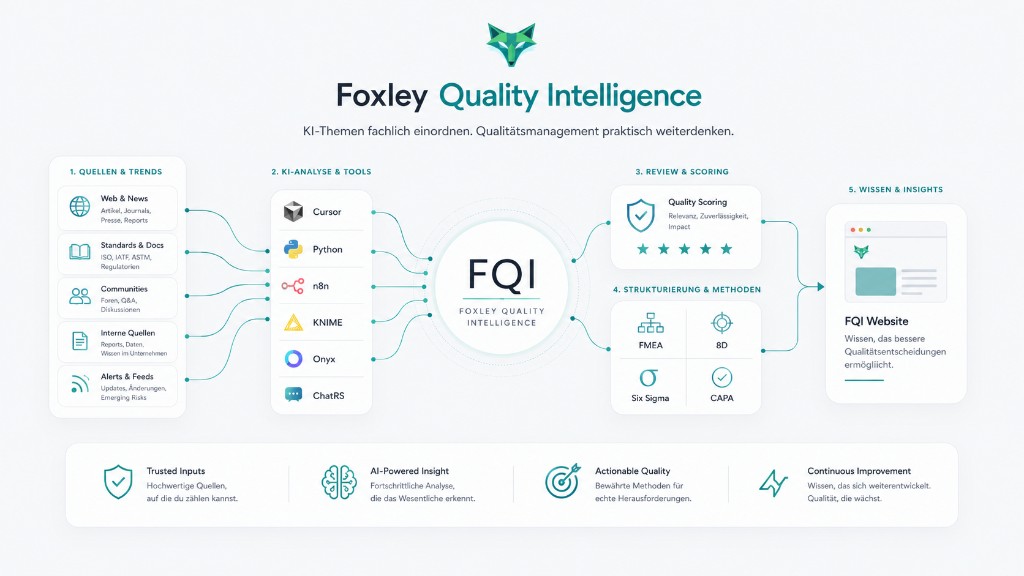
Foxley Quality Intelligence is not a news aggregator or a fully automatic content generator. FQI connects source monitoring, AI-supported analysis, methodical assessment and professional review into reports that are meant to help in real quality management work.
The workflow below shows how scattered information becomes structured FQI Insights.
1. Monitor sources & trends
Relevant developments appear not only in journals, but also in standards, forums, product announcements, community discussions and internal lessons learned. FQI deliberately collects different source types:
- Web & news — articles, trade media, press and reports on AI, automation and quality
- Standards & documents — norms, guidelines and regulatory signals
- Communities — forums, Q&A and professional discussions
- Own practical experience — Publicly or lawfully usable professional knowledge. No confidential company data, customer data, supplier data or unreleased internal documents are published.
- Alerts & feeds — updates, changes and emerging risks
The goal is not completeness for its own sake, but a reliable input from which patterns, relevance and open questions can be identified.
2. Apply AI analysis & tools
Raw information is turned into structure, connections and working hypotheses. Practical tools are used for this — including Cursor, Python, n8n, KNIME, Ollama and other local or controllable AI systems.
AI mainly supports tasks such as:
- clustering and condensing topics
- recognising links to QM methods
- making recurring questions and risks visible
- preparing drafts for professional assessment
What matters: AI proposes — professional judgement remains human.
3. Review & scoring
Not every interesting item becomes a report. Before publication, FQI checks among other things:
- Relevance — what does the topic mean for quality management, production or inspection processes?
- Reliability — how well is the claim supported? Where are data or experience missing?
- Impact — could the topic concretely influence decisions, methods or processes?
This produces quality scoring and a decision on whether and how deeply a report is published.
4. Structuring & QM methods
FQI does not assess topics in isolation, but in the context of established quality logic. Typical reference points include:
- FMEA — risks, failure effects, prevention potential
- 8D — problem solving, root cause analysis, sustainability of actions
- Six Sigma — variation, data basis, process stability
- CAPA — correction, prevention, effectiveness
The result is not generic AI news, but assessments with methodological backbone.
5. Publish knowledge & insights
Published content appears as FQI Insights on this website: traceable, filterable by topics and methods, with a clear distinction between observation, assessment and open questions.
The goal is knowledge that prepares better quality decisions — not hype, not tool advertising and no ready-made patent recipes.
What FQI deliberately is not
- not a substitute for standards, audits or binding expert opinions
- not a fully automatic content stream without review
- not a services or consulting website
- not a claim to completeness of all AI developments
What matters in the end
FQI is meant to help understand developments earlier, assess them professionally and place them practically: where does value emerge? Where are data, validation or responsibilities still unclear? And which conclusions are actually robust for quality work?
Trusted inputs
Sources with clear origin and traceable relevance for quality work.
AI with control
Analysis and structuring — without handing off professional responsibility.
Methodical assessment
Links to FMEA, 8D, Six Sigma, CAPA and practical QM questions.
Continuous development
The knowledge base grows with new topics, reviews and experience.